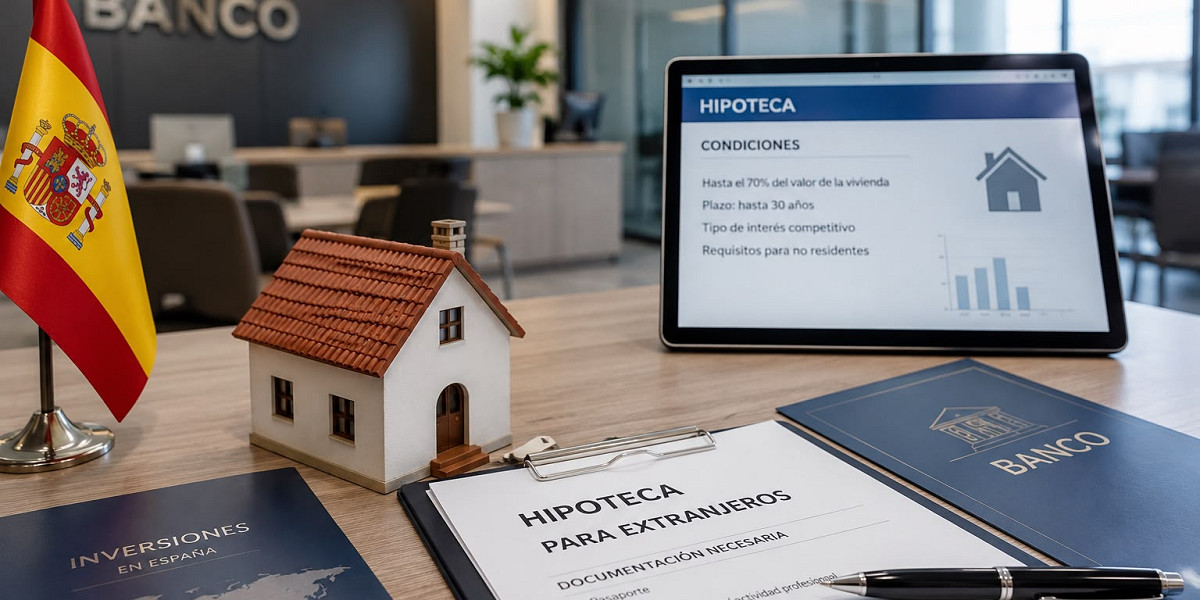
How can a foreign buyer obtain financing for an apartment, house or villa in Spain?
Foreign buyers can obtain mortgage financing to purchase property in Spain, whether or not they are Spanish tax residents.
However, banks generally assess non-resident applicants more conservatively because their income, assets and credit history may be located outside Spain.
The amount financed, interest rate and loan term depend on the buyer's financial profile, country of residence, income currency, type of property and the bank's valuation.
For this reason, mortgage financing should ideally be considered before signing an arras agreement and paying a substantial deposit.
Can a non-resident get a mortgage in Spain?
Yes. Spanish banks provide mortgage financing to foreign buyers and non-residents.
Not being a Spanish resident does not automatically prevent a buyer from obtaining a mortgage.
Banks generally assess:
- stability of income;
- level of income;
- existing debts;
- savings and assets;
- country of tax residence;
- currency of income;
- source of funds;
- borrower's age;
- value and liquidity of the property.
Each application is assessed individually.
What percentage of the property value can a bank finance?
For a primary residence, Spanish banks may finance up to 80% of the property value for suitable applicants.
Financing for second homes and non-resident buyers is generally more conservative. Depending on the bank and financial profile, financing of around 60–70% may be available.
Banks usually calculate the maximum loan based on the lower of:
- the purchase price;
- the appraised value — tasación.
If a property is purchased for €600,000 but valued by the bank at €550,000, the mortgage will normally be calculated using the €550,000 valuation.
Example of mortgage financing
Suppose a foreign buyer purchases an apartment for €500,000.
If the bank approves financing of 60%, the mortgage would amount to:
€500,000 × 60% = €300,000
The buyer would therefore need to provide at least €200,000 of their own funds.
Taxes and acquisition costs must also be budgeted separately, as they are generally not included in mortgage financing.
How much own capital does the buyer need?
The amount of own funds required depends mainly on the loan-to-value ratio approved by the bank.
With 60% financing, the buyer must provide the remaining 40% of the property value plus taxes and purchase costs.
With 70% financing, the buyer needs at least 30% plus the transaction costs.
Foreign buyers should therefore be prepared to contribute a significant amount of their own capital.
What types of income do banks accept?
Spanish banks may consider different types of documented income, including:
- salary;
- self-employed income;
- dividends;
- business income;
- rental income;
- pensions;
- other regular documented income.
The main requirement is that the income must be stable, understandable and supported by official documentation.
Business owners and entrepreneurs may be required to provide considerably more information than salaried employees.
How much debt can the borrower have?
Banks assess not only income but also the applicant's existing financial obligations.
These may include:
- existing mortgages;
- car loans;
- personal loans;
- credit card balances;
- maintenance or alimony payments;
- other recurring financial commitments.
The higher the existing debt burden, the lower the potential mortgage amount.
Banks pay particular attention to the relationship between monthly debt payments and the borrower's net income. The exact affordability criteria vary between financial institutions.
What documents does a foreign buyer need?
The precise list depends on the bank and the applicant's country of residence.
Banks commonly request:
- passport;
- NIE;
- proof of address;
- tax returns;
- proof of income;
- employment contract;
- bank statements;
- details of existing loans;
- proof of savings and assets;
- documentation relating to the property.
Business owners may additionally need to provide:
- company accounts;
- corporate tax returns;
- evidence of ownership;
- financial statements;
- proof of dividends received.
The bank may request further documentation depending on the applicant's financial structure.
Source of funds checks
Banking compliance is an important part of the mortgage process for foreign buyers.
The bank may ask for documentation proving the source of the money used for the deposit and purchase.
Possible sources include:
- salary savings;
- dividends;
- sale of another property;
- sale of a business;
- inheritance;
- investment income.
If a large amount of money is transferred to a Spanish bank shortly before completion, the bank may request documentation explaining the complete origin of the funds.
It is advisable to begin this process well in advance.
Does the country of residence affect the bank's decision?
Yes.
The bank considers the applicant's country of tax residence, local financial system, ability to verify documentation and currency of income.
Applicants from certain jurisdictions may be subject to additional documentation requirements or longer compliance procedures.
Banks must also comply with international AML and KYC requirements relating to anti-money laundering and customer identification.
In what currency is the mortgage granted?
Most mortgages used to purchase property in Spain are denominated in euros.
If the borrower's income is also in euros, currency risk is limited.
If income is received in US dollars, pounds sterling or another currency, the bank takes exchange-rate risk into account.
A significant fall in the value of the borrower's income currency against the euro could increase the effective cost of monthly mortgage payments.
Currency exposure should therefore be considered when structuring the financing.
What types of mortgage rates are available?
Three principal types of mortgage are commonly available in Spain:
- fixed-rate mortgage;
- variable-rate mortgage;
- mixed-rate mortgage.
A fixed-rate mortgage maintains the agreed interest rate throughout the loan term.
A variable-rate mortgage is normally linked to Euribor plus a bank margin.
A mixed-rate mortgage provides a fixed interest rate for an initial period and then switches to a variable rate.
The most suitable option depends on current market rates, the term of the loan and the borrower's attitude to interest-rate risk.
How long can a mortgage term be?
The mortgage term depends on the bank, the borrower's age and financial profile.
Mortgage products with terms of 20 to 30 years are common in the Spanish market.
However, banks may offer shorter terms to non-residents.
The borrower's age at the expected date of final repayment is also taken into consideration.
Why is a bank valuation required?
Before final mortgage approval, the property undergoes an official valuation — tasación.
The valuation helps the bank establish the market value of the property and determine the maximum amount it is prepared to lend.
The price agreed between the buyer and seller is not the bank's only reference.
If the valuation is lower than the purchase price, the available mortgage may be reduced.
This risk should be considered when negotiating the arras agreement.
Who pays for the valuation?
The property valuation is normally paid for by the borrower.
Under the current Spanish mortgage framework, the bank generally bears the notary, Land Registry, tax and gestoría costs directly related to establishing the mortgage loan.
Taxes and costs relating to the property purchase itself remain separate expenses for the buyer.
Mortgage pre-approval
Before selecting a final property, foreign buyers should ideally obtain a preliminary assessment of their financial profile from a bank.
The bank analyses the applicant's income and financial obligations and may provide an approximate financing range.
This helps determine:
- maximum purchase budget;
- potential mortgage amount;
- required down payment;
- approximate monthly payment.
However, mortgage pre-approval is not a guarantee that the loan will ultimately be granted.
Final approval normally depends on the property valuation, legal review of the asset and completion of the bank's compliance process.
Mortgage clause in the arras agreement
One of the most serious mistakes a buyer can make is signing an arras agreement while relying on mortgage financing without addressing the possibility of a bank refusal.
If arras penitenciales are signed without a financing condition, a buyer who cannot obtain the mortgage may lose the deposit.
The agreement should therefore clearly establish:
- required mortgage amount;
- minimum financing percentage;
- deadline for obtaining approval;
- consequences of a low valuation;
- evidence required to demonstrate a bank refusal;
- conditions for refunding the deposit.
The clause should be drafted precisely rather than relying on a general statement that the purchase is “subject to mortgage approval”.
Can the mortgage be arranged after signing arras?
Yes. This is common in Spanish property transactions.
However, the period between signing arras and completion must provide sufficient time for:
- mortgage application;
- document review;
- property valuation;
- bank risk assessment;
- compliance checks;
- preparation of mortgage documentation.
An unrealistically short arras period may create a significant risk for the buyer.
What is the FEIN?
Once a mortgage has been approved, the bank provides the borrower with a FEIN — Ficha Europea de Información Normalizada, the European Standardised Information Sheet.
This document sets out the principal conditions of the mortgage offer.
It includes information such as:
- loan amount;
- term;
- interest rate;
- monthly instalments;
- fees;
- early repayment conditions;
- required or linked products.
Before signing the mortgage, the borrower must complete the legally established pre-contractual information process.
Is a Spanish bank account required?
In practice, a Spanish bank account is normally required when arranging a mortgage in Spain.
It is used for:
- disbursement of the mortgage;
- monthly repayments;
- insurance payments;
- other banking transactions.
Banks may also offer a reduced interest rate when the borrower contracts additional products, such as insurance or salary payment services.
Mortgage offers should therefore be compared on the basis of the overall cost of financing, not only the headline interest rate.
Can a mortgage be repaid early?
Yes.
A mortgage can normally be repaid partially or in full before the contractual maturity date.
The agreement may provide for compensation to the bank for early repayment within the limits permitted by Spanish law.
Early repayment conditions should therefore be reviewed before the mortgage contract is signed.
Main reasons why banks refuse a mortgage
A bank may reject a mortgage application for several reasons.
The most common include:
- insufficient income;
- unstable income;
- excessive existing debt;
- inability to prove the source of funds;
- adverse credit history;
- insufficient own capital;
- low property valuation;
- legal issues affecting the property;
- complex income structure;
- incomplete documentation.
A refusal by one bank does not necessarily mean that mortgage financing is impossible.
Different banks use different risk assessment policies.
Common mistakes made by foreign buyers
The most frequent mistakes include:
- choosing a property before assessing mortgage capacity;
- assuming maximum financing will be available without preliminary approval;
- failing to budget for taxes and purchase costs;
- signing arras without a mortgage clause;
- allowing too little time to complete the purchase;
- starting banking compliance too late;
- failing to prepare source-of-funds documentation;
- calculating the mortgage only from the purchase price;
- ignoring the risk of a low valuation;
- comparing banks only by interest rate.
Mortgage financing should be considered part of the overall acquisition strategy rather than a separate process started after selecting a property.
How to prepare for a mortgage application
Before signing an arras agreement, a foreign buyer should:
- determine the amount of available own capital;
- prepare proof of income;
- calculate existing debt obligations;
- collect banking and tax documentation;
- prepare evidence of the source of funds;
- obtain preliminary assessments from several banks;
- determine the potential mortgage amount;
- maintain a reserve of own funds;
- include an appropriate financing clause in the arras agreement;
- allow sufficient time before notarial completion.
This approach significantly reduces the risk of finding the right property but being unable to complete the transaction because financing is unavailable.
Conclusion
Foreign buyers and non-residents can obtain mortgages to purchase property in Spain, although financing conditions are generally determined individually and may be more conservative than those offered to Spanish residents buying their primary home.
Banks assess income, debt obligations, own capital, country of residence, source of funds and the property being purchased.
For non-residents and second homes, financing of around 60–70% may be available depending on the bank and the borrower's profile, while the final mortgage amount also depends on the bank valuation.
The key rule for foreign buyers is to begin the mortgage process before entering into significant contractual commitments and to protect the purchase with an appropriate financing condition in the arras agreement.
GG Real Estate Barcelona assists international buyers purchasing property in Barcelona, Catalonia and other regions of Spain.
We help determine the acquisition budget, coordinate communication with Spanish banks, arrange the property valuation and legal due diligence, and accompany the buyer through the arras agreement and notarial completion.
Frequently asked questions
Can a foreigner get a mortgage in Spain?
Yes. Spanish banks provide mortgages to foreign nationals and non-residents who meet their lending requirements.
What percentage of the property price can a foreign buyer finance?
It depends on the buyer's profile and the property. For non-residents and second homes, financing of around 60–70% is commonly considered, although every application is assessed individually.
What value does the bank use to calculate the mortgage?
The mortgage is generally calculated using the lower of the purchase price and the official appraised value.
Do I need an NIE to obtain a mortgage?
A foreign buyer will need an NIE for the property transaction and related banking procedures.
Who pays for the property valuation?
The borrower normally pays the cost of the tasación.
Can I obtain a mortgage without being resident in Spain?
Yes. Non-residents can obtain Spanish mortgages, although banks may offer a lower loan-to-value ratio and request additional documentation.
What happens if the bank refuses the mortgage after I sign arras?
If the arras agreement does not contain a properly drafted financing condition, the buyer may risk losing the deposit.
When should I start the mortgage application?
Ideally, the buyer should obtain a preliminary bank assessment before signing arras and before making a final commitment to the transaction.