What does the Land Registry extract show and why does a property buyer need it?
A Nota Simple is one of the key documents that should be obtained before buying property in Spain.
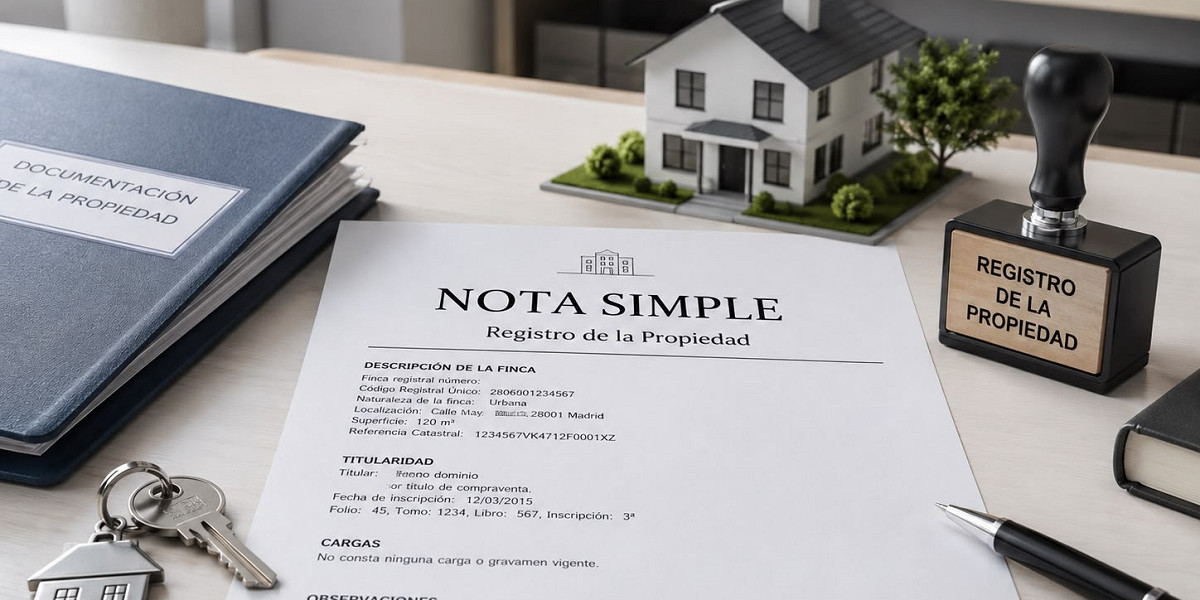
It is an informative extract from the Registro de la Propiedad — Land Registry that allows the buyer to review the legal description of the property, the registered owner and the main rights or encumbrances recorded against the asset.
For a buyer, the Nota Simple is one of the first tools used to check a property. However, it is important to understand that the document itself does not constitute complete legal due diligence and does not guarantee that there are no other risks.
What is a Nota Simple?
A Nota Simple Informativa is an informative document issued by the Registro de la Propiedad for a specific property.
It reflects the principal information recorded in the Land Registry at the time the document is issued.
In practical terms, it helps answer three basic questions:
- what property is registered;
- who owns it;
- what registered rights or encumbrances affect it.
For this reason, the Nota Simple should normally be obtained before signing an arras agreement.
What information does a Nota Simple contain?
The exact content depends on the property, but it normally includes:
- details of the relevant Land Registry;
- finca registral number;
- legal description of the property;
- address;
- registered area;
- property characteristics;
- owner details;
- ownership share;
- basis of acquisition;
- mortgages;
- seizures or liens;
- usufruct rights;
- easements;
- restrictions;
- other registered rights and encumbrances.
The document should be read as a legal summary rather than simply as a property description.
What is a finca registral?
Each registered property has its own finca registral.
This is the legal unit recorded in the Land Registry.
It does not always correspond exactly to the way the property is physically presented or marketed.
For example, an apartment, parking space and storage room may be:
- included in one finca registral;
- registered as separate fincas;
- treated as annexes to another registered property.
Before buying, it is important to confirm exactly which registered assets are included in the agreed purchase price.
Who is the registered owner?
One of the most important sections of the Nota Simple is the titularidad, or ownership information.
It identifies the registered owner or owners and the type of right each person holds.
If several people own the property, the buyer should verify:
- each owner's share;
- the legal basis of ownership;
- who must sign the sale documents;
- whether representatives are acting;
- whether their powers are sufficient.
If the seller does not match the person shown in the Land Registry, the situation should be clarified before any substantial payment is made.
What does pleno dominio mean?
The term pleno dominio generally means full ownership.
However, the Nota Simple may also show other types of rights.
For example:
- usufructo — right to use the property and receive income from it;
- nuda propiedad — bare ownership without the current right of use;
- a partial ownership share.
It is therefore not enough simply to see the seller's name. The buyer must understand what type of right the seller actually owns.
Mortgages in a Nota Simple
If the property is mortgaged, the mortgage will normally appear in the section dealing with cargas or encumbrances.
The Nota Simple may identify the registered mortgage and the lender.
The existence of a mortgage does not automatically prevent the property from being sold.
Many properties in Spain are sold before the seller has fully repaid their mortgage.
In such cases, the buyer should establish:
- the current outstanding debt;
- the amount to be paid to the bank;
- how repayment will be organised;
- how the mortgage will be cancelled in the Land Registry.
The original mortgage liability recorded in the Nota Simple does not necessarily equal the seller's current outstanding loan balance.
Seizures and court restrictions
A Nota Simple may show an embargo, or seizure, as well as other court-related restrictions.
These may arise from:
- unpaid public debts;
- litigation;
- tax debts;
- enforcement proceedings;
- other obligations of the owner.
Such entries should never be ignored.
The buyer must understand the origin of the restriction, the amount involved and how it will be removed before completion.
Easements
The Nota Simple may contain registered servidumbres — easements.
These are rights that may limit the use of a property or grant certain rights to third parties.
Examples include:
- right of way;
- vehicle access;
- utility rights;
- use of part of a plot;
- other restrictions.
For a standard city apartment, some easements may have limited practical effect. For a villa or plot of land, they can be highly significant.
Usufruct rights
If the document contains a usufructo, a third party may have the right to use the property or receive income from it.
For example, one person may own the nuda propiedad while another holds the usufruct.
In such a situation, the buyer cannot automatically assume that one owner alone can transfer all rights in the property.
The entire structure of registered rights should be reviewed.
Registered area of the property
The Nota Simple includes a registered description and area.
However, this may differ from:
- cadastral information;
- the estate agency listing;
- physical measurements;
- architectural plans.
For example, a terrace may have been enclosed, a house extended or a swimming pool added without the corresponding changes being recorded in the Land Registry.
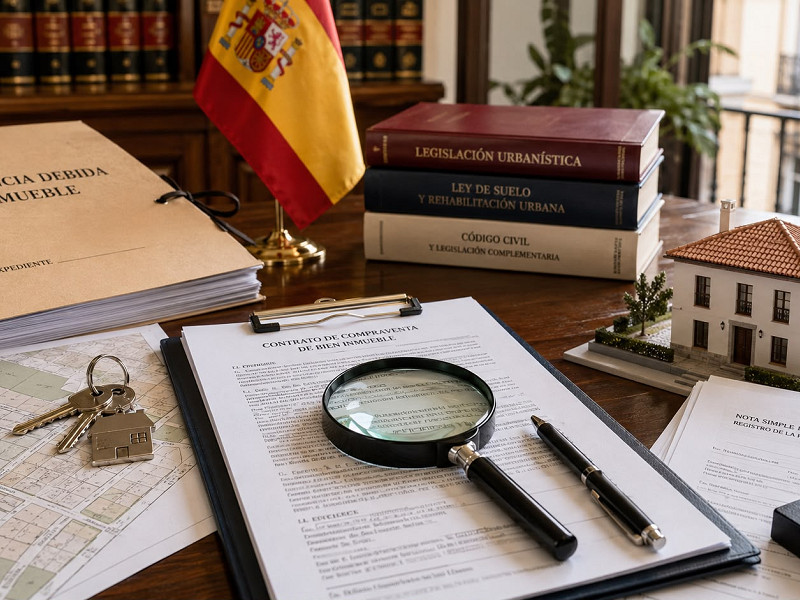
The Nota Simple should therefore be compared with other documentation.
Nota Simple and Catastro are not the same
The Registro de la Propiedad and Catastro serve different purposes.
The Nota Simple shows registered legal rights over the property.
The Catastro contains administrative and cadastral information about the asset.
A proper legal review may therefore compare:
- Nota Simple;
- referencia catastral;
- cadastral documentation;
- escritura;
- actual physical condition of the property.
Any discrepancies should be analysed before purchase.
What does a Nota Simple not show?
One of the most common mistakes is to treat the Nota Simple as a complete guarantee that the property is legally clean.
It reflects registered information, but it does not necessarily reveal every potential problem.
A Nota Simple alone may not confirm:
- debts to the community of owners;
- future derramas;
- physical condition of the property;
- unauthorised renovations;
- municipal planning violations;
- condition of installations;
- possibility of tourist rental;
- all tenancy issues;
- urban planning restrictions;
- whether all building licences exist.
The document is therefore an important part of due diligence, but it does not replace it.
How recent should the Nota Simple be?
A buyer should use an up-to-date Nota Simple.
The document reflects the status of the Land Registry at the time it is issued.
The legal position can change later.
For this reason, a Nota Simple obtained several months earlier should not automatically be relied upon for a current purchase.
Fresh registry information should be obtained before important contractual commitments.
When should the Nota Simple be requested?
Ideally, the Nota Simple should be obtained before signing an arras agreement.
At that stage, the buyer should at least confirm:
- who owns the property;
- that the registered asset matches the property being offered;
- whether mortgages exist;
- whether there are seizures;
- whether there are other significant registered restrictions.
Paying a substantial deposit first and only then beginning the registry review puts the buyer in a weaker position.
Is the Land Registry checked again at the notary?
Yes.
Before notarial completion, updated Land Registry information is obtained.
This allows the notary to verify important aspects such as the registered owner and existing mortgages or other encumbrances.
However, this does not remove the need for the buyer to review the property before signing arras.
Nota Simple and certificación registral
A Nota Simple should not be confused with a certificación registral.
Both documents may contain information about the property, ownership and encumbrances, but they have different legal value.
The Nota Simple is primarily informative.
A certificación registral is the formal registry document used when official proof of the contents of the Land Registry is required.
For most preliminary property checks, a Nota Simple is sufficient.
For formal proof of a particular registered circumstance, a certificación may be necessary.
How can a Nota Simple be ordered?
A Nota Simple can be requested from the Registro de la Propiedad or through the official online services of Registradores de España.
Depending on the information available, the property may be identified using:
- finca registral details;
- CRU/IDUFIR;
- address;
- referencia catastral;
- owner details.
The more precise the registration data, the easier it is to identify the correct property.
How much does a Nota Simple cost?
When ordered through the official Registradores de España platform, the cost of an electronic Nota Simple is relatively low.
Buyers should distinguish the official registry service from private intermediary websites, which may charge significantly more for obtaining the same document.
In professional transactions, the buyer's lawyer or representative will normally obtain and review the document directly.
Can a Nota Simple be obtained in English?
The official registry system may offer translation services for international users.
However, the original Spanish document remains the primary registry information.
A translated version may help a foreign buyer understand the document, but complex entries or encumbrances should still be interpreted by a professional.
How to read a Nota Simple
The document can appear technical to a buyer who is unfamiliar with Spanish real estate terminology.
The main sections generally relate to:
- registry identification;
- finca information;
- descripción;
- titularidad;
- cargas;
- additional registry entries.
What matters is not only the wording but also its legal meaning.
For example, the presence of a mortgage does not show the current balance of the loan, and the existence of an easement does not automatically mean that the property is problematic.
What should you do if a mortgage appears?
If the Nota Simple shows a mortgage, further information should be requested from the seller.
Before completion, the buyer should establish:
- lender;
- current outstanding balance;
- repayment procedure;
- amount to be transferred to the bank;
- issuance of a debt-free certificate where applicable;
- subsequent cancellation of the mortgage in the Registry.
The buyer should understand the full cancellation mechanism before final payment.
What if the seller's details do not match?
If the seller does not match the registered owner, it is risky to sign arras before the reason has been established.
Possible explanations include:
- an inheritance that has not yet been registered;
- a representative acting under power of attorney;
- ownership through a company;
- a previous transaction not yet entered in the Registry;
- multiple owners.
In every case, the documentation confirming the seller's authority should be reviewed.
What if the area does not match?
If the area shown in the Nota Simple differs from the Catastro or physical property, the cause must be established.
Depending on the situation, it may be necessary to consider:
- cadastral correction;
- rectification of the Land Registry;
- declaración de obra nueva;
- surveying documentation;
- technical plans;
- municipal regularisation.
Significant discrepancies in villas and houses should be investigated before purchase.
Nota Simple for new-build property
The review of a new-build property can be different.
At an early stage, an individual apartment may not yet have its own independent finca registral.
The review may therefore include:
- the underlying land;
- the developer's ownership rights;
- obra nueva;
- división horizontal;
- construction documentation;
- developer financing;
- the legal status of the future unit.
A Nota Simple alone is therefore not sufficient for an off-plan or new-build purchase.
Nota Simple when buying with a mortgage
If the buyer is obtaining mortgage financing, the bank will also review the property's registry status.
The bank must confirm that the asset is suitable security for the loan.
Serious encumbrances or legal issues may need to be resolved before financing is released.
However, the bank's review is primarily carried out to protect the lender and should not replace independent buyer due diligence.
Common mistakes made by buyers
The most frequent mistakes include:
- failing to obtain a Nota Simple before arras;
- relying on an old extract;
- checking only the owner's name;
- ignoring the cargas section;
- assuming a mortgage has already been cancelled;
- overlooking easements;
- failing to compare Registry and Catastro;
- treating the area shown in an advertisement as official;
- assuming the Nota Simple shows all debts;
- confusing a Nota Simple with complete legal due diligence;
- unnecessarily using expensive intermediary websites.
A Nota Simple is useful only if the information it contains is interpreted correctly.
How to use a Nota Simple safely when buying
Before buying, it is advisable to:
- obtain an up-to-date Nota Simple;
- verify the owner;
- understand the type of ownership right;
- check mortgages;
- review seizures and other cargas;
- analyse easements and third-party rights;
- compare the description with the purchase agreement;
- compare the Registry and Catastro;
- verify the physical condition of the property;
- request additional documents where issues arise;
- complete the wider legal due diligence;
- only then assume substantial financial obligations.
This approach considerably reduces the buyer's legal risks.
Conclusion
A Nota Simple is one of the principal documents used for an initial legal review of property in Spain.
It helps establish what property is registered, who owns it and which registered encumbrances or third-party rights affect it.
However, a Nota Simple is an informative document reflecting the status of the Land Registry at the time of issue. It does not replace checks of the Catastro, community debts, IBI, urban planning, licences, physical condition and other relevant documentation.
The key rule is to obtain and properly analyse an up-to-date Nota Simple before signing an arras agreement and paying a substantial deposit.
GG Real Estate Barcelona represents buyers and assists with residential and investment property acquisitions in Barcelona, Catalonia and other regions of Spain.
We obtain and analyse the Nota Simple, verify ownership and encumbrances, compare Land Registry and cadastral information, carry out legal due diligence, prepare the arras agreement and accompany the buyer through notarial completion and registration of ownership.
Frequently asked questions
What is a Nota Simple in Spain?
It is an informative extract from the Registro de la Propiedad containing key information about the property, registered owner and registered encumbrances.
Does a Nota Simple show a mortgage?
If a mortgage remains registered against the property, it will normally appear in the cargas section.
Does it show community debts?
No. Community debts must be checked separately with the comunidad de propietarios.
How long is a Nota Simple valid?
There is no universal fixed validity period for a property purchase. It reflects the Land Registry at the time of issue, so an up-to-date extract should be used before the transaction.
Can a Nota Simple be ordered online?
Yes. It can be requested through the official online services of Registradores de España.
What is the difference between Nota Simple and certificación registral?
The Nota Simple is primarily informative. A certificación registral is used when formal proof of the contents of the Land Registry is required.
Is a Nota Simple enough for a safe purchase?
No. It is a key due diligence document, but cadastral information, debts, urban planning, licences and other matters may also need to be checked.