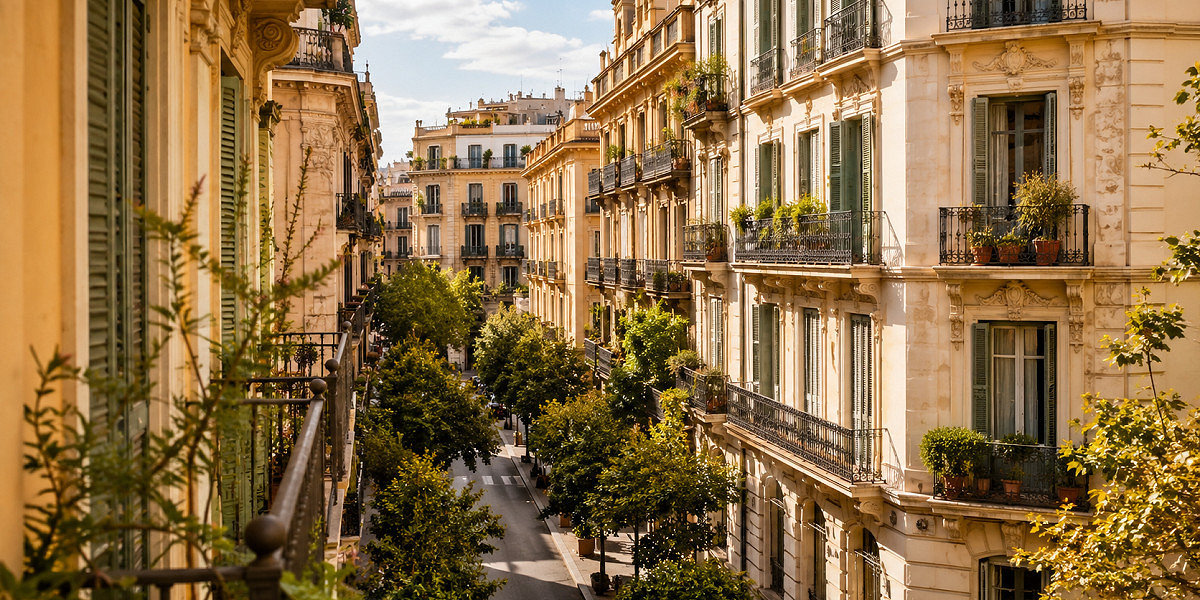
Property Prices in Spain: Housing Cost Overview
Property prices in Spain continue to rise, but the market remains uneven. The cost of housing depends not only on the country or region, but also on the city, district, type of property, building condition, proximity to the sea, transport accessibility, legal clarity and investment potential.
For buyers, this means one thing: the average price in Spain is not enough to make a decision. An apartment in Madrid, a flat in Barcelona, a villa on the Costa Brava, a house in Valencia and a rental investment property on the Costa Blanca are different markets with different pricing logic.
General Price Situation
The Spanish real estate market is in a phase of stable growth. After a period of demand recovery, rising mortgage rates and the subsequent return of buyer activity, purchasers are once again actively entering the market. At the same time, supply remains limited, especially in major cities, coastal areas and locations with strong international demand.
The main reason for price growth is the imbalance between supply and demand. Spain is creating more new households than new homes are being delivered. This is especially noticeable in Madrid, Barcelona, Valencia, Málaga, Alicante, the Balearic Islands and other popular locations. Quality properties in good areas quickly find buyers, and their prices rarely fall significantly.
At the same time, the market has become more selective. Buyers are willing to pay for a strong location, good property condition, terrace, view, parking, lift, energy efficiency and legal transparency. Properties with disadvantages, inflated prices or complex legal status may take longer to sell.
How Much Property Costs in Spain
The average housing price in Spain has already exceeded €2,000 per square metre and continues to rise. In reality, however, the price range is very wide.
In less expensive inland regions of Spain, housing can be found at significantly more affordable prices. In smaller towns and areas without strong tourist or international demand, the cost per square metre can be noticeably below the national average.
In major cities and popular coastal areas, prices are higher. In Madrid, Barcelona, San Sebastián, Palma de Mallorca, Málaga, Marbella, the Costa Brava and premium areas of the Costa del Sol, the cost of quality real estate can be several times higher than the Spanish average.
It is especially important to understand that the price per square metre does not always reflect the real value of a property. Two apartments of the same size can differ greatly in price because of the floor, orientation, view, building condition, lift, terrace, parking, renovation quality or rental potential.
New Builds and Resale Property
New-build properties in Spain usually cost more than resale homes. This is due to the limited supply of new projects, rising construction costs and strong demand for modern, energy-efficient properties.
Buyers choose new builds for their layouts, technical condition, parking spaces, swimming pools, communal areas, modern materials and lower renovation costs after purchase. In good locations, the best apartments in new developments can be sold at the early stages of construction.
The resale market is much larger in volume. This is where most apartments in central districts, homes in established residential communities and properties by the sea are found. Resale property may be more attractive in terms of price, but it requires more careful due diligence: building condition, debts, technical documents, ITE, comunidad fees, legal status and possible restrictions on renovation.
For buyers, the choice between a new build and a resale property depends on the objective. If a modern format, energy efficiency and minimal work after purchase are important, a new build may be more convenient. If the main priority is location, liquidity and the opportunity to buy in an already established area, the resale market often offers more options.
Where Property in Spain Is Most Expensive
The highest prices are traditionally concentrated in locations with limited supply, high income levels and international demand.
These markets include Madrid, Barcelona, the Balearic Islands, San Sebastián, Marbella, premium areas of the Costa del Sol, the Costa Brava, as well as selected districts of Valencia, Málaga and Alicante.
In Barcelona, the most expensive properties are located in Eixample, Sarria-Sant Gervasi, Pedralbes, Les Corts, Diagonal Mar and prestigious areas near Passeig de Gracia. In Madrid, high prices are typical of Salamanca, Chamberí, Chamartín, Retiro and other central or premium districts.
On the coast, price depends on proximity to the sea, views, privacy, the quality of the residential community and the type of property. A villa with sea views in a good area of the Costa Brava or Marbella may cost significantly more than an apartment of similar size in an ordinary urban district.
Where Prices Remain More Affordable
More affordable prices can be found in inland regions of Spain, smaller towns, less tourist-driven provinces and areas where demand is mainly formed by local buyers. In such locations, the entry price is lower, but liquidity must be assessed carefully.
For an investor, a cheap property does not always mean a good purchase. If an area has weak rental demand, no stable economy, few jobs or difficult demographic trends, a low price may be accompanied by low liquidity. Such a property may be difficult to sell or rent out on attractive terms.
Therefore, when analysing affordable markets, it is important to look not only at price, but also at potential: infrastructure, transport, employment, tourist flow, universities, district development and tenant demand.
Why Prices Are Rising
Property prices in Spain are rising due to several factors.
Supply shortage
Not enough new housing is being built, especially in the regions where demand is growing fastest. Administrative procedures, shortage of land, rising construction costs and the limited number of new projects make supply rigid.
Stable demand
Spain remains an attractive country for living, investment, relocation and buying a second home. Climate, safety, healthcare, schools, transport accessibility and quality of life support interest from both local and foreign buyers.
Foreign demand
In coastal regions and major cities, foreign buyers play a noticeable role. They often buy more expensive properties, especially in premium locations, by the sea or in areas with international infrastructure.
Rental demand
In cities with strong rental demand, investors view real estate as a source of income. This supports prices for properties suitable for long-term, medium-term or corporate rental.
The Purchase Price Is Not the Full Cost of the Transaction
Buyers should take into account not only the property price, but also additional costs. In Spain, these can vary significantly depending on the region and type of property.
When buying resale property, the main tax is ITP. Its rate depends on the autonomous community. When buying a new build, buyers usually pay IVA and AJD. It is also necessary to account for notary fees, property registration, legal support, bank costs in the case of a mortgage and possible valuation expenses.
After purchase, regular expenses appear: IBI, comunidad fees, insurance, maintenance, utilities, non-resident tax obligations and management costs if the owner does not live in Spain permanently.
That is why a proper budget calculation should include not only the property price, but also the full cost of the transaction and ownership.
How to Assess Whether a Property Price Is Fair
To understand whether the price corresponds to the market, it is not enough to compare the property with several listings on portals. Listings show sellers’ expectations, not always real transaction prices.
A professional valuation should take into account:
real transactions in the area;
building condition;
floor and orientation;
presence of a lift, terrace and parking;
renovation quality;
legal status of the property;
comunidad fees;
rental demand;
liquidity of the street and micro-location;
potential for growth or resale.
It is especially important to analyse properties carefully in Barcelona, Madrid, the Costa Brava, Costa Maresme, Costa del Sol and the Balearic Islands, where the difference between neighbouring streets can significantly affect value.
Property Price Forecast in Spain
In the near future, property prices in Spain are likely to continue rising, but unevenly. The most resilient markets are major cities, coastal areas, locations with international demand and areas with limited supply.
The pace of growth may change depending on mortgage rates, purchasing power, the economic situation and the volume of new construction. However, the structural shortage of supply remains the main factor supporting prices.
For buyers, this means that waiting for a sharp price drop in the best locations may not be the most effective strategy. A more rational approach is to analyse the specific market, choose a liquid property and negotiate based on real data.
Conclusion
Property prices in Spain are rising, but the market remains very diverse. There are expensive premium locations, more affordable regions, markets for living, rental income, capital preservation and long-term investment.
The key point is not to rely only on the national average price. To make the right purchase, buyers need to understand the specific location, property type, legal status, costs, rental potential and future liquidity.
GG Real Estate Barcelona helps buyers analyse property prices in Spain, compare regions and districts, evaluate properties, negotiate and complete transactions safely. This is especially important in a market where quality supply is limited and a pricing mistake can be costly.